



Submission Package
The submission package must include:
- An official submission letter from the institution where the research was conducted.
- The manuscript.
Institutional Submission Letter
- The letter must follow the submitting institution’s approved template.
- The letter must confirm that:
- the article has not been published previously and has not been submitted to any other publication for consideration;
- the article contains no information covered by the List of Information Constituting State Secrets;
- the article has been approved for publication by the submitting institution’s Expert Council.
- The letter must bear the approval and signature of the head of the institution and the institution’s official seal.
- All authors must sign the final page of the letter.
Manuscript
The manuscript must be typed in 12-point Times Roman, with 1.5-line spacing, on one side of A4 paper, with 2.5 cm margins on both sides.
The manuscript must include:
- A title page.
- An abstract:
- in Russian (1,800 characters, including spaces);
- in English (professionally translated).
- Keywords:
- in Russian;
- in English.
- The main text.
Original research articles should be no longer than 8–10 typed pages, and case reports no longer than 3–4 pages. Lectures and review articles should be no longer than 15–20 pages.
The main text must be divided into the following sections:
- Introduction
- Materials and Methods
- Results
- Discussion
- Conclusion/Conclusions
- Tables
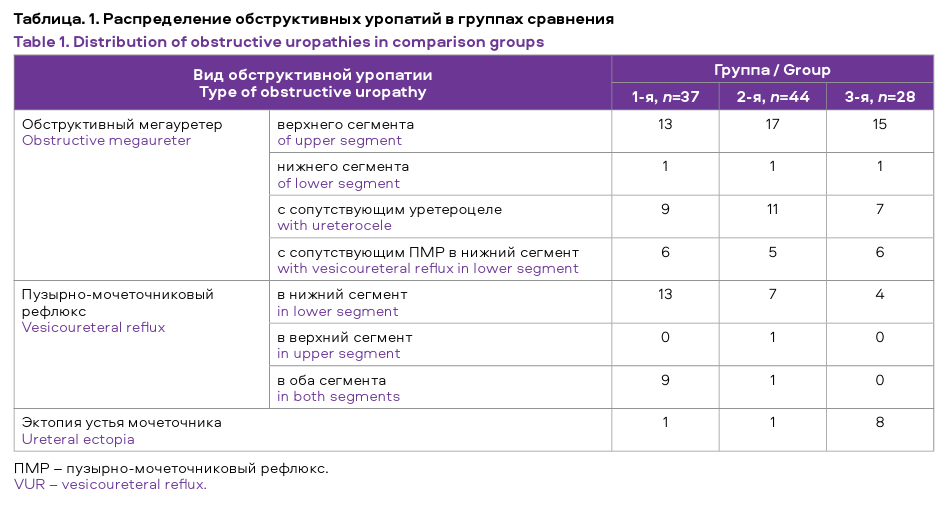
Table titles must be provided in both Russian and English. The contents of all tables must also be provided in English.
Example:
- Figures
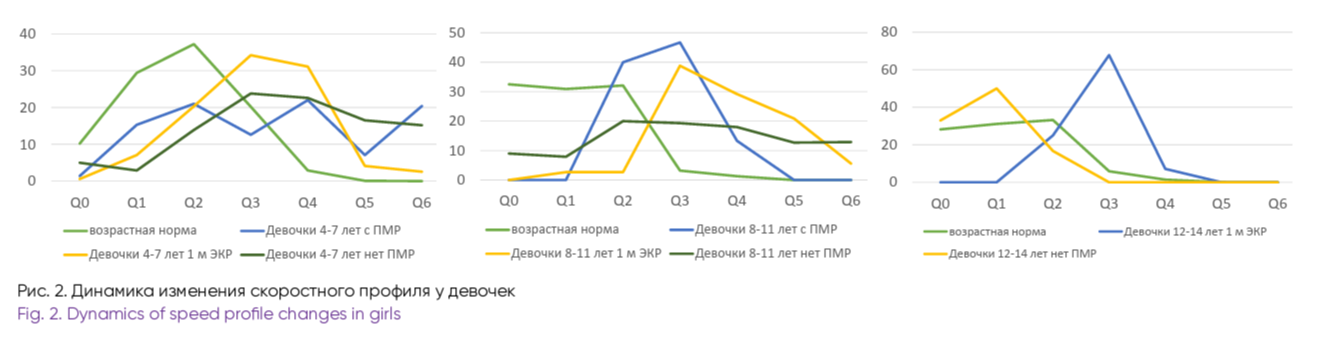
Figure titles must be provided in both Russian and English.
Example:
- References
- At least 10 references for case reports.
- At least 20 references for original research articles.
- No more than 70 references for literature reviews.
- All manuscript pages must be numbered.
Title Page
The title page must include:
- The article title:
- in Russian;
- in English.
- The surnames, initials, and affiliations of all authors:
- in Russian;
- in English.
- The full, unabbreviated name of the institution where the research was conducted, including its postal address and postal code:
- in Russian;
- in English.
- The corresponding author’s surname, first name, patronymic, telephone number, and email address:
- in Russian;
- in English.
Author Information
Author information must be provided in both Russian and English in the following format:
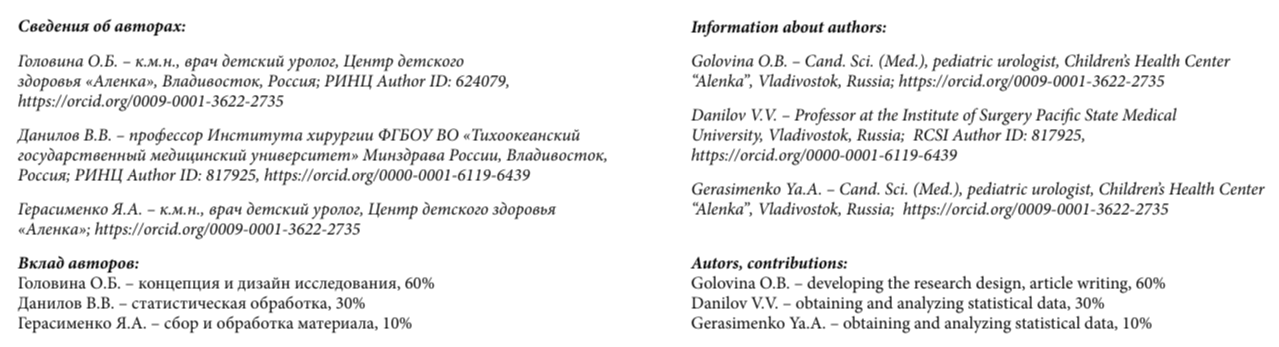
- Surname, first name, patronymic — position, affiliation, email address, Russian Science Citation Index (RSCI) ID in the Russian version, and ORCID iD in the English version.
- Each author’s contribution to the article must be described in words and expressed as a percentage, in both Russian and English, using the following format:
Example:
- Conflicts of interest. The article must fully disclose any conflicts of interest affecting any of the authors.
- Funding.
Structure of Original Research Articles
Introduction. State the aim and objectives of the study and briefly outline the current state of knowledge, citing the most relevant publications.
Materials and Methods. Describe the materials and research methods used.
Results. Present the results in a logical sequence in the text, tables, and figures. Figures should not duplicate data presented in tables. Figures and photographs should preferably be submitted in color. Photographs must be submitted in .jpg format at a resolution of 600 dpi. The data must be subjected to statistical analysis. Figure legends must be typed on the same page with 1.5-line spacing and numbered using Arabic numerals corresponding to the figure numbers. Each legend must include a title and explanatory text. Legends for photomicrographs must specify the magnification. Measurements must be expressed in International System of Units (SI) units.
Tables. Each table must be typed on a separate page with 1.5-line spacing and must have a title and a sequential number corresponding to the order in which it is cited in the text. Each column must have a concise heading.
Discussion. Highlight the new and significant findings of the study and, where possible, compare them with findings reported by other authors.
Conclusion. Summarize the main findings and conclusions of the study.
Reference Formatting Guidelines (Vancouver Style)
General requirements for the reference list:
- References must be listed in the order in which they are cited.
- All references must be numbered consecutively in the order of their first citation in the manuscript, rather than alphabetically. In-text citations must use Arabic numerals in square brackets. When citing multiple sources, list their numbers in ascending order, separated by commas without spaces.
- The manuscript must not cite sources that are absent from the reference list.
- Number of references: original research articles should preferably cite no more than 25–30 sources, and literature reviews no more than 70.
- References to online sources must include the same bibliographic information as references to printed sources, including authors’ surnames, the title, the URL, and other relevant details.
Formatting examples:
Journal Articles
- The titles of Russian-language journals must be written in full. Journal titles may be abbreviated only if the abbreviated form is listed in PubMed or Index Medicus.
- Journal titles in the reference list must be italicized.
- Journal Title year;volume(issue):pages
- If an article has six or fewer authors, all authors must be listed in the reference.
Examples:
- Sigaev A.V., Mitusov V.V., Kireev A.Yu., Kogan M.I. Does hypogonadism affect the outcomes of transurethral resection for benign prostatic hyperplasia? Urology Herald 2013;(2):21-26.
- Wu FCW, Tajar A, Beynon JM, Pye SR, Silman AJ, Finn JD, et al. Identification of late-onset hypogonadism in middle-aged and elderly men. N Engl J Med 2010;363(2):123-135. doi: 10.1056/NEJMoa0911101.
- Apolikhin O.I., Katibov M.I., Sivkov A.V., Chernyshev I.V., Roshchin D.A., Shaderkin I.A., et al. Challenges in prostate cancer screening arising from population-wide health examinations in the Russian Federation. Social Aspects of Population Health [online scientific journal] 2013;34(6). URL: http://vestnik.mednet.ru/content/view/519/30/lang,ru/ (Accessed February 3, 2014).
Books
If a book has one to six authors, all authors must be listed in the reference.
Examples:
- Shcheplev P.A. Andrology. Clinical Guidelines. 2nd ed., revised and expanded. Moscow: Medpraktika-M Publishing House; 2012. 150 p.
- Nieschlag E, Behre HM. Male infertility due to testicular
dysfunction. In Infertility [Templeton A.A., Drife JO. eds]. London: Springer-Verlag 1992. P. 65-79. doi: 10.1007/978-1-4471-1962-3_4.
Electronic Resources
The URL must link directly to the cited resource, rather than merely to the website hosting it. Both the date the document was published on the website and the date it was accessed must be provided.
Dissertation Abstracts and Dissertations
Please note: references to dissertation abstracts, dissertations, and conference or symposium proceedings are not accepted.
References
In the References section, Russian-language sources must be presented in the following order: authors’ surnames (using the authors’ preferred transliteration), article title (transliterated), article title (English translation in square brackets), journal title (transliterated), and publisher (transliterated). The publication details, provided in numerical format, must be followed by the source language designation (in Russian). The journal title must be italicized.
Online tools may be used to facilitate transliteration, for example: http://translate.meta.ua/translit/
Transliteration example:
- Sigaev A.V., Mitusov V.V., Kireev A.Yu., Kogan M.I. Vliyaet li gipogonadizm na rezultaty transuretralnoy rezektsii dobrokachestvennoy giperplazii predstatelnoy zhelezy? [Does hypogonadism affect the outcomes of transurethral resection for benign prostatic hyperplasia?]. Vestnik urologii 2013;(2):21-26. (In Russian)
Digital Object Identifier (DOI)
To meet the requirements of international databases, a digital object identifier (DOI) must be included at the end of each reference to an English-language or Russian-language publication, where available. Publications can be located by DOI on the International DOI Foundation (IDF) and CrossRef websites. These websites can also be used to find the DOI of a cited article.
General Guidelines
- Authors must follow the Uniform Requirements for Manuscripts Submitted to Biomedical Journals, developed by the International Committee of Medical Journal Editors.
- The Editorial Board reserves the right to edit submitted materials, provide commentary on published materials, and decline publication.
- If an article is not accepted for publication, the manuscript will not be returned, and the author will receive an explanation of the decision.
- The manuscript must include information on compliance with ethical requirements for research involving human participants, including patients’ informed consent to participate, and laboratory animals.
All materials must be submitted electronically in Microsoft Word format (version 93–97 or later) and emailed to viktoriashade1@mail.ru.