
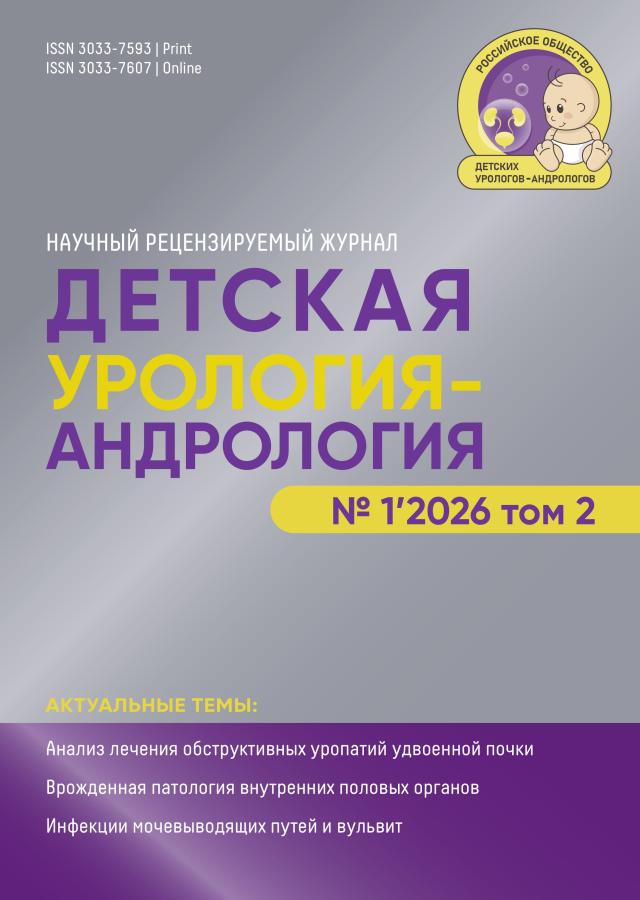



№1’2026, part 1
Topic of the issue:

Analysis of surgical treatment of pediatric patients with obstructive uropathies of duplicated kidney

№1’2025, part 1
Topic of the issue:

Microsurgical subinguinal varicocelectomy by Marmar – the importance of optical magnification

Urinary tract infections and vulvitis: evaluation of potential causal relationships

№1’2026, part 1- page. 35-44
For citation:

Sibirskaya E.V., Karachentsova I.V., Nikiforova P.O., Danilko D.D. Urinary tract infections and vulvitis: evaluation of potential causal relationships. Pediatric Urology-Andrology. 2026;2(1):35–44. https://doi.org/10.29188/3033-7593/2026-2-1-35-44

Sibirskaya E.V, Karachentsova I.V, Nikiforova P.O., Danilko D.D
Information about authors:
  • Sibirskaya E.V. – Dr. Sc. (Med.), Professor of the Department of Obstetrics, Gynecology and Reproductive Medicine of the Russian University of Medicine of the Ministry of Health of the Russian Federation; Professor of the Department of Obstetrics and Gynecology named after Academician G.M. Savelyeva of the Institute of Motherhood and Childhood of the Pirogov Russian National Research Medical University; Head of the Surgical Gynecological Department of the Russian Children’s Clinical Hospital of the Pirogov Russian National Research Medical University, Moscow, Russia; https://orcid.org/0000-0002-4540-6341
  • Karachentsova I.V. – Cand. Sci. (Med.), Associate Professor of the Department of Obstetrics and Gynecology named after Academician G.M. Savelyeva of the Institute of Motherhood and Childhood of the Pirogov Russian National Research Medical University; obstetrician-gynecologist of the Department of Pediatric Gynecology of the Russian Children’s Clinical Hospital of the Pirogov Russian National Research Medical University, Moscow, Russia
  • Nikiforova P.O. – Doctor of the Gynecological Department of the Russian Children’s Clinical Hospital of the Pirogov Russian National Research Medical University; postgraduate student of the Department of Obstetrics and Gynecology named after Academician G.M. Savelyeva of the Institute of Motherhood and Childhood of the Pirogov Russian National Research Medical University, Moscow, Russia; https://orcid.org/0000-0001-5046-9016
  • Danilko D.D. – 5th year student at the Institute of Motherhood and Childhood of the Pirogov Russian National Research Medical University (Pirogov University), Moscow, Russia; https://orcid.org/0009-0007-5764-7066
11
Download PDF

Introduction. This review is dedicated to analyzing the relationship between urinary tract infections (UTIs) and vulvovaginitis (VV) in prepubertal girls – a frequent and clinically significant comorbid pathology.

Objective: to systematize modern data on the etiopathogenesis, clinical features, and principles of differential diagnosis of combined urogenital pathology – UTIs and VV – in prepubertal girls, with an emphasis on assessing the cause-and-effect relationships between these conditions.

Material and Methods. An analytical review of Russian and foreign scientific literature was conducted, including publications in peer-reviewed medical journals, clinical guidelines, and epidemiological research data. The analysis included studies focusing on the anatomical and physiological features of the urogenital tract in girls, microbiological, immunological, and clinical aspects of UTIs and VV, as well as issues of diagnosis and treatment. The methodology is based on the comparative analysis and synthesis of data from selected sources to identify patterns and construct pathogenetic and diagnostic models.

Results. Analysis of the literature established a close relationship between UTIs and VV in girls. This connection is due to common anatomical and physiological prerequisites (proximity of structures, hypoestrogenism, immune system immaturity) and a shared spectrum of pathogens, primarily intestinal microflora, especially Escherichia coli. The predominant pathogenetic scenario is the development of a UTI as a complication of primary VV, though a reverse link is also possible. A key clinical and diagnostic problem is the similarity of symptoms (dysuria, leukocyturia), leading to frequent errors such as overdiagnosis of UTIs. The crucial diagnostic element identified is the mandatory examination of the external genitalia, upon which a stepwise diagnostic algorithm is proposed.

Conclusion. The relationship between UTIs and vulvitis in girls is a natural phenomenon that forms a vicious cycle of mutual infection and chronicity. To break this cycle, clear differential diagnosis is necessary, based on the mandatory examination of the genitalia and the application of a comprehensive laboratory and instrumental approach. Effective management of patients with combined urogenital pathology requires interdisciplinary collaboration between a pediatrician, a pediatric gynecologist, and a nephrologist/urologist.

Attachment Size
Download 174.34 KB
Keywords: urinary tract infections; vulvitis; vulvovaginitis; girls; prepubertal age; comorbidity; etiology; pathogenesis; differential diagnosis; Escherichia coli; dysuria; leukocyturia; diagnostic algorithm; interdisciplinary approach; urogynecology